---
date: "Last updated: June 14^th^, 2026"
subtitle: 2026
title: Generalised readings
---
In 2025, I found plenty of time to listen to podcasts, but didn't make
enough time for more challenging reads. To resolve this imbalance, I
purchased an Audible subscription and I have resolved to read (listen
to) at least 26 books this year. After reading each book, I'll log it
here with a brief summary of my takeaways and some reflections.
I'm thinking of reading mostly non-fiction books this year, to balance
out an emphasis on fiction in previous years and to make progress in
building my understanding of the world.
A pattern that has emerged after the first few books is that I want to
look out for things I learn in each book I read that are of relevance to
my work in AI safety and alignment. Of course, I typically pick books
that have *some* chance of relevance since both my work and my book
choices are downstream of my broad interests, but often the specific
connections I spot are unexpected.
**Contents:**
- [1. *Deep Utopia* by Nick
Bostrom](#deep-utopia-by-nick-bostrom){#toc-deep-utopia-by-nick-bostrom}
- [2. *Feline Philosophy* by John
Gray](#feline-philosophy-by-john-gray){#toc-feline-philosophy-by-john-gray}
- [3. *Replacing Guilt* by Nate
Soares](#replacing-guilt-by-nate-soares){#toc-replacing-guilt-by-nate-soares}
- [4. *What is Life?* by Erwin
Schrödinger](#what-is-life-by-erwin-schrödinger){#toc-what-is-life-by-erwin-schrödinger}
- [5. *Why Greatness Cannot be Planned* by Kenneth O. Stanley and Joel
Lehman](#why-greatness-cannot-be-planned-by-kenneth-o.-stanley-and-joel-lehman){#toc-why-greatness-cannot-be-planned-by-kenneth-o.-stanley-and-joel-lehman}
- [6. *The Art of Doing Science and Engineering* by Richard
Hamming](#the-art-of-doing-science-and-engineering-by-richard-hamming){#toc-the-art-of-doing-science-and-engineering-by-richard-hamming}
- [Up next?](#up-next){#toc-up-next}
` `{=html}
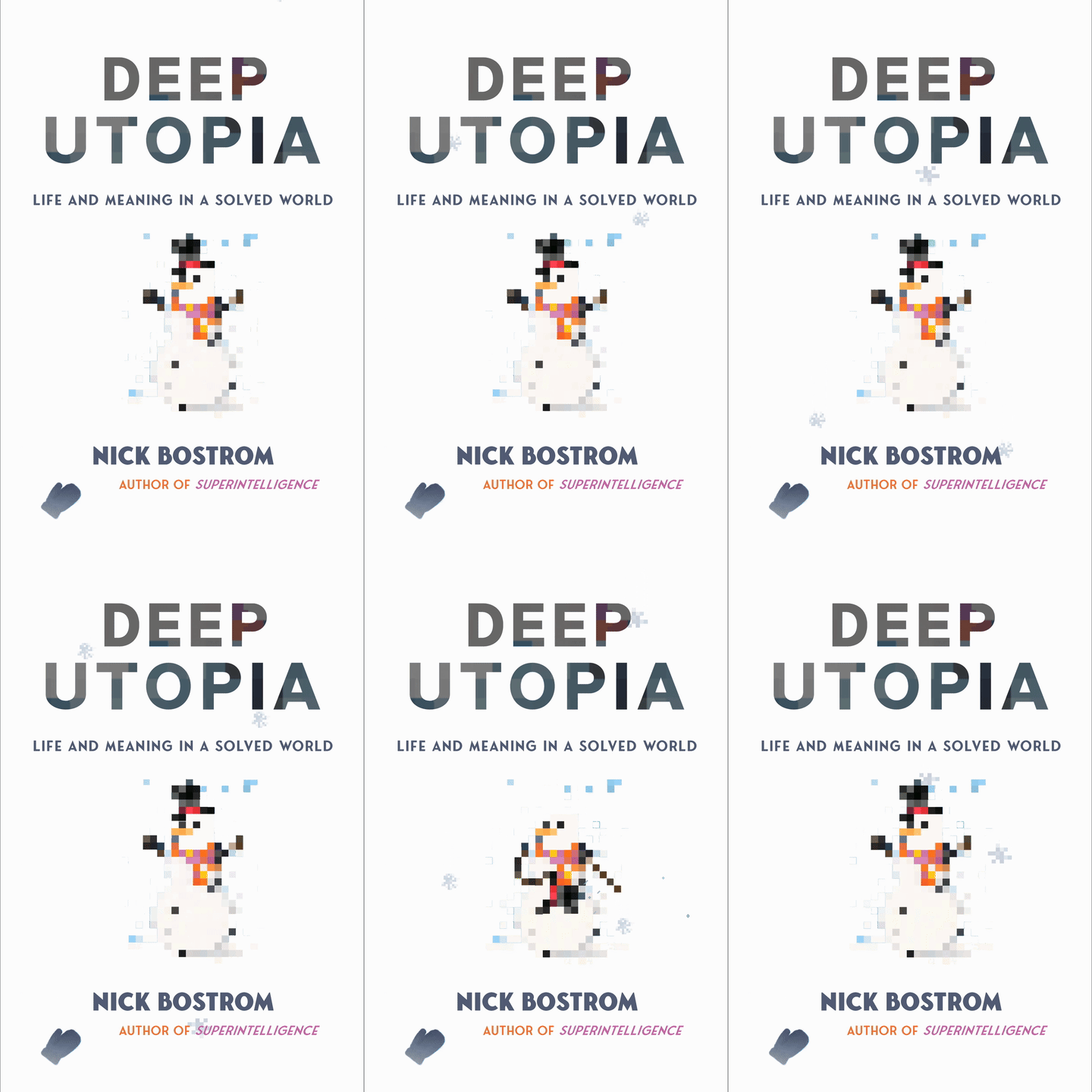
## 1. *Deep Utopia* by Nick Bostrom
*Audible audiobook (2.0x), Jan 23--31, 2026.*
[Bostrom](https://en.wikipedia.org/wiki/Nick_Bostrom) is a futurist and
philosopher, and *Deep Utopia* (2024) is his exploration of the
potential and limitations of a realistic utopian future for humanity. I
got a lot out of reading *Superintelligence* [back in the
day](readings-2019-to-2025) so I had been meaning to give this new book
a try since it came out.
Channeling Plato, the book's philosophical discussion is framed as a
fictional series of lectures delivered by Bostrom, interleaved with
dialogues between a group of friends auditing the class. Bostrom also
splices in various technical readings, including some stories from
alternative universes in which sentient animals or appliances strive
towards their own utopian visions. I suspect there were some allegorical
elements of the alternative universe stories and the hints at university
(dis)function that went over my head, but I mostly came for the explicit
philosophical discussion in the lectures, and I think I was able to
follow most of that.
As with *Superintelligence,* the philosophical discussion revealed to me
that concepts I had a folk understanding of were actually deeper than
they appeared, or introduced useful concepts and distinctions that I
think I will find useful in framing my thinking going forward. For
example:
- Bostrom taxonomises various barriers humanity could face in
implementing a utopia, beyond just physical limits and also
including various 'reachability' constraints. I appreciated this
broader and unified discussion of constraints.
- Bostrom had a habit of asking, for a given human value, why do we
have that value? This is obviously of interest to me as an alignment
researcher. He repeatedly appealed to a concept of
'intrinsification,' where instrumentally useful things over time
come to seem instrinsically valuable to us.
I think these kinds of things are good examples of the value of reading
good philosophy, and I am overall happy I read the book.
Also as with *Superintelligence,* I didn't find *all* of the book's
discussion philosophically satisfying. For example:
- One recurring theme that stood out was that I generally felt that
the topic of developing humans into the best versions of themselves
was under-treated. Perhaps this is out of scope as Bostrom is
specifically talking about a utopia for *us,* present humans. I
think I might just have an intuitively broader notion of *us* that
includes some of who we *could be?* I'm not sure, I would have liked
to see how Bostrom would frame this. He does discuss some related
issues of identity loss later in the series.
- A more pedantic complaint. At a couple of points Bostrom suggests
creating isolated situations where humans limit their access to
utopian technological affordances in order to achieve certain kinds
of value that the affordances undermines. He explicitly says that
one could consider these people to be leaving utopia, but he prefers
to consider the isolated situations as still being part of utopia. I
didn't appreciate this being dismissed so readily.
I will say, I had a much longer list of incredulous margin notes in
*Superintelligence.* It's on my mind to re-read that some day and see
how well my complaints hold up.
Overall, the book seemed incomplete to me. I would have liked to see
more of the stories of Feodor the Fox and ThermoRex the space
heater---it felt like there was more to develop in both. Moreover, the
final lecture in the fictional series was also open to the public, and
consequently dropped most of the prior motivation of discussing utopia
in order to give Bostrom's self-contained account of 'the meaning of
life.' I was hoping there would be a final discussion that connected
this account back to the discussion of utopia, explored how our search
for meaning would play out in utopia.
Note: This was a long and dense book. I followed fine, but I don't think
I will retain most of it. Of course, I would ideally like to retain
valuable things I read this year, so, going forward, I'm going start
trying to take notes while reading and write a summary of the key ideas
in each book as I see them at the end.
`
`{=html}
## 1. *Deep Utopia* by Nick Bostrom
*Audible audiobook (2.0x), Jan 23--31, 2026.*
[Bostrom](https://en.wikipedia.org/wiki/Nick_Bostrom) is a futurist and
philosopher, and *Deep Utopia* (2024) is his exploration of the
potential and limitations of a realistic utopian future for humanity. I
got a lot out of reading *Superintelligence* [back in the
day](readings-2019-to-2025) so I had been meaning to give this new book
a try since it came out.
Channeling Plato, the book's philosophical discussion is framed as a
fictional series of lectures delivered by Bostrom, interleaved with
dialogues between a group of friends auditing the class. Bostrom also
splices in various technical readings, including some stories from
alternative universes in which sentient animals or appliances strive
towards their own utopian visions. I suspect there were some allegorical
elements of the alternative universe stories and the hints at university
(dis)function that went over my head, but I mostly came for the explicit
philosophical discussion in the lectures, and I think I was able to
follow most of that.
As with *Superintelligence,* the philosophical discussion revealed to me
that concepts I had a folk understanding of were actually deeper than
they appeared, or introduced useful concepts and distinctions that I
think I will find useful in framing my thinking going forward. For
example:
- Bostrom taxonomises various barriers humanity could face in
implementing a utopia, beyond just physical limits and also
including various 'reachability' constraints. I appreciated this
broader and unified discussion of constraints.
- Bostrom had a habit of asking, for a given human value, why do we
have that value? This is obviously of interest to me as an alignment
researcher. He repeatedly appealed to a concept of
'intrinsification,' where instrumentally useful things over time
come to seem instrinsically valuable to us.
I think these kinds of things are good examples of the value of reading
good philosophy, and I am overall happy I read the book.
Also as with *Superintelligence,* I didn't find *all* of the book's
discussion philosophically satisfying. For example:
- One recurring theme that stood out was that I generally felt that
the topic of developing humans into the best versions of themselves
was under-treated. Perhaps this is out of scope as Bostrom is
specifically talking about a utopia for *us,* present humans. I
think I might just have an intuitively broader notion of *us* that
includes some of who we *could be?* I'm not sure, I would have liked
to see how Bostrom would frame this. He does discuss some related
issues of identity loss later in the series.
- A more pedantic complaint. At a couple of points Bostrom suggests
creating isolated situations where humans limit their access to
utopian technological affordances in order to achieve certain kinds
of value that the affordances undermines. He explicitly says that
one could consider these people to be leaving utopia, but he prefers
to consider the isolated situations as still being part of utopia. I
didn't appreciate this being dismissed so readily.
I will say, I had a much longer list of incredulous margin notes in
*Superintelligence.* It's on my mind to re-read that some day and see
how well my complaints hold up.
Overall, the book seemed incomplete to me. I would have liked to see
more of the stories of Feodor the Fox and ThermoRex the space
heater---it felt like there was more to develop in both. Moreover, the
final lecture in the fictional series was also open to the public, and
consequently dropped most of the prior motivation of discussing utopia
in order to give Bostrom's self-contained account of 'the meaning of
life.' I was hoping there would be a final discussion that connected
this account back to the discussion of utopia, explored how our search
for meaning would play out in utopia.
Note: This was a long and dense book. I followed fine, but I don't think
I will retain most of it. Of course, I would ideally like to retain
valuable things I read this year, so, going forward, I'm going start
trying to take notes while reading and write a summary of the key ideas
in each book as I see them at the end.
` `{=html}
## 2. *Feline Philosophy* by John Gray
*Audible audiobook (2.0x), Feb 2--9, 2026.*
*Feline Philosophy* (2020) is a short exploration of the contrast
between the ways cats and humans orient to life. I learned a few cool
things about cats. According to Gray:
- Domestic cats are very genetically similar to their wild ancestors,
apart from having slightly shorter legs and more colourful fur.
- They also have smaller brains, but it's particularly the parts of
the brain responsible for 'fight or flight' response that has
shrunk, presumably because their environment tends to be somewhat
less hostile.
*Aside:* It's amazing how often I find things that seem relevant to
AI alignment when reading random books! ``{=html}
- Cats have never been pack animals, they are independent. They are
happy to live with humans, but they don't think in terms of
hierarchies of dominance. They will form groups of cats only out of
convenience. They will love humans but not in a dependent way.
- Cats are "selfless egoists." This sounds oxymoronic but he means
they are egoists in that they think only of their own needs while
also being selfless in the specific sense that they don't concern
themselves with their identity or self-image.
This leads Gray to claim that cats were never domesticated---rather,
they domesticated humans. Fun line; it [reminds
me](/readings-2019-to-2025#on-history) of Harari's take on the
agricultural revolution from the perspective of crops.
The book made general claims about cat behaviour, and drew examples
mostly from cats in literature or biographies, so I'm not sure how
carefully each of these claims has been studied. But they seem
plausible.
Anyway, of course, the book was just as much, if not more, about humans
as it was about cats. Here's some things I learned about humanity.
- First of all, it's striking that at one point it was totally normal
for people to think cats were unworthy of moral consideration, or
worse:
- Descartes experimented on cats, managing to somehow prove in the
process of torturing them that the cats had no souls. (I think
he experimented on dogs in similar ways too.) Philosophy of mind
is hard, I guess?
- Western religious societies until relatively recently viewed
cats as devils, sometimes ritually burning them alive. (Of
course they also did this to women accused of witchcraft.)
- Even scientists used to feel totally free to torture cats in
order to study pain. (These days there are animal ethics
guidelines that might stop this but I think I have met some
scientists that would be sympathetic to it on utilitarian
grounds.)
- On the other hand, animist civilisations like Egyptians saw cats as
embodiments of gods. To me this shows that very many different
civilisational world views are possible.
- According to Gray, cats teach us that the meaning of life is in the
living of life and not in the questioning of why. From what I hear
about his other writing, he views humans as more similar to animals
than they like to think. Except, he points out, humans have
self-awareness and accordingly self-consciousness and this leads to
their problems.
- Humans orient to the world by writing stories about their lives.
However, this makes it difficult when the stories are disrupted,
can lock them into unpleasant roles (such as when someone views
their life as tragic, they can become unable to escape the
tragedy), and prompts people to think ahead prematurely to their
own death (the end of their story).
- He links self awareness to the fall of man---once you know you
are in paradise, you are no longer in paradise.
There was quite a lot more in the book. Stories of many historical
philosophers who had written about similar topics, and several cats and
their owners, friends, and foes. These were interesting but I didn't
focus as much on remembering the details.
I think I extracted the main message of the book, that we should live
more in the moment. But the book was a bit meandering, so it wasn't
obvious what the hierarchy of ideas was meant to be. There is a nice
list of ten principles at the end, and the book was short and sweet, so
would be pretty easy to re-read.
`
`{=html}
## 2. *Feline Philosophy* by John Gray
*Audible audiobook (2.0x), Feb 2--9, 2026.*
*Feline Philosophy* (2020) is a short exploration of the contrast
between the ways cats and humans orient to life. I learned a few cool
things about cats. According to Gray:
- Domestic cats are very genetically similar to their wild ancestors,
apart from having slightly shorter legs and more colourful fur.
- They also have smaller brains, but it's particularly the parts of
the brain responsible for 'fight or flight' response that has
shrunk, presumably because their environment tends to be somewhat
less hostile.
*Aside:* It's amazing how often I find things that seem relevant to
AI alignment when reading random books! ``{=html}
- Cats have never been pack animals, they are independent. They are
happy to live with humans, but they don't think in terms of
hierarchies of dominance. They will form groups of cats only out of
convenience. They will love humans but not in a dependent way.
- Cats are "selfless egoists." This sounds oxymoronic but he means
they are egoists in that they think only of their own needs while
also being selfless in the specific sense that they don't concern
themselves with their identity or self-image.
This leads Gray to claim that cats were never domesticated---rather,
they domesticated humans. Fun line; it [reminds
me](/readings-2019-to-2025#on-history) of Harari's take on the
agricultural revolution from the perspective of crops.
The book made general claims about cat behaviour, and drew examples
mostly from cats in literature or biographies, so I'm not sure how
carefully each of these claims has been studied. But they seem
plausible.
Anyway, of course, the book was just as much, if not more, about humans
as it was about cats. Here's some things I learned about humanity.
- First of all, it's striking that at one point it was totally normal
for people to think cats were unworthy of moral consideration, or
worse:
- Descartes experimented on cats, managing to somehow prove in the
process of torturing them that the cats had no souls. (I think
he experimented on dogs in similar ways too.) Philosophy of mind
is hard, I guess?
- Western religious societies until relatively recently viewed
cats as devils, sometimes ritually burning them alive. (Of
course they also did this to women accused of witchcraft.)
- Even scientists used to feel totally free to torture cats in
order to study pain. (These days there are animal ethics
guidelines that might stop this but I think I have met some
scientists that would be sympathetic to it on utilitarian
grounds.)
- On the other hand, animist civilisations like Egyptians saw cats as
embodiments of gods. To me this shows that very many different
civilisational world views are possible.
- According to Gray, cats teach us that the meaning of life is in the
living of life and not in the questioning of why. From what I hear
about his other writing, he views humans as more similar to animals
than they like to think. Except, he points out, humans have
self-awareness and accordingly self-consciousness and this leads to
their problems.
- Humans orient to the world by writing stories about their lives.
However, this makes it difficult when the stories are disrupted,
can lock them into unpleasant roles (such as when someone views
their life as tragic, they can become unable to escape the
tragedy), and prompts people to think ahead prematurely to their
own death (the end of their story).
- He links self awareness to the fall of man---once you know you
are in paradise, you are no longer in paradise.
There was quite a lot more in the book. Stories of many historical
philosophers who had written about similar topics, and several cats and
their owners, friends, and foes. These were interesting but I didn't
focus as much on remembering the details.
I think I extracted the main message of the book, that we should live
more in the moment. But the book was a bit meandering, so it wasn't
obvious what the hierarchy of ideas was meant to be. There is a nice
list of ten principles at the end, and the book was short and sweet, so
would be pretty easy to re-read.
` `{=html}
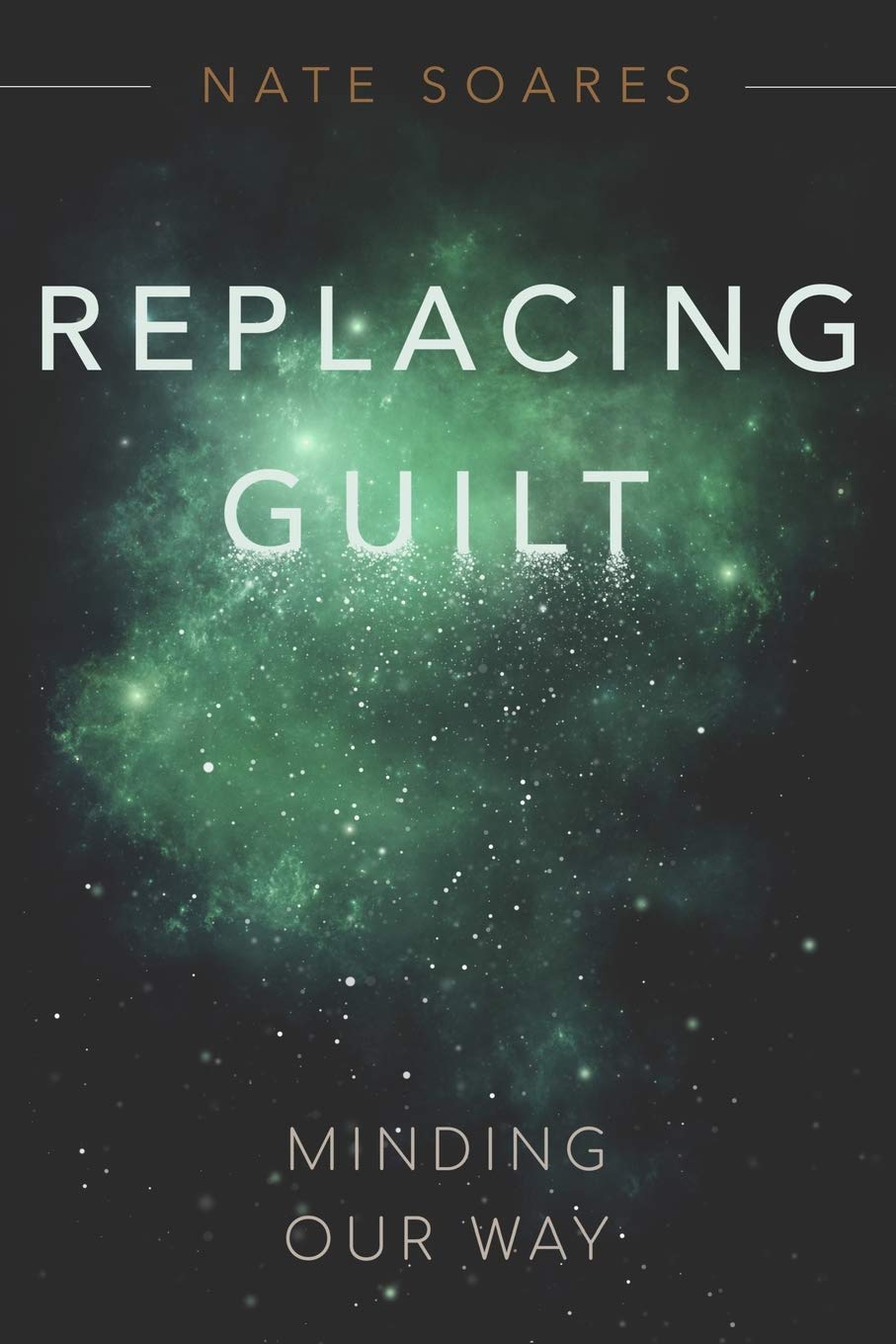
## 3. *Replacing Guilt* by Nate Soares
*Podcast audiobook (1.5x), Feb 15--27, 2026.*
[Nick Marsh](https://marsh.blue/) recommended I pick up this 2015--2016
sequence by Nate Soares. Apart from reading *Rationality: from AI to
Zombies,* I haven't engaged much with LessWrong sequences. Time to start
working on that. Note that as part of my broad definition of
"generalised readings," I'm happy to count a thematic collection of
essays towards my yearly goal. As it happens, this collection does have
an overarching structure, and has technically been [published as a
book](https://replacingguilt.com/), and there is an [official audio
version](https://creators.spotify.com/pod/profile/guilt/episodes/Replacing-Guilt-full-audiobook-e13ct4d/a-a5vrdtu)
by Gianluca Truda (this is the version I listened to).
This time, I experimented with taking much more detailed notes than for
the previous readings. During and after each essay, I would try to
summarise the structure of the argument in my own terms. This was a
useful exercise and ultimately helped me get a lot more out of the book,
to the point where I could afterwards synthesise the below detailed
summary. However, the detailed note-taking made it less convenient to
listen, for example it was hard to listen while doing housework, and a
little dangerous to listen while walking down High Street typing notes
into my phone. I don't expect to be able to keep this up for all of the
books I read going forward. By default, I probably want to revert to
listening without feeling obligated to take detailed notes (unless I
specifically want to study a particular book in this much detail). I
might try listening more slowly than 2x speed by default, as a
compromise.
Anyway, in this case, I took the detailed notes. I thought the ideas
were valuable enough that it was worth spending the time to write myself
a detailed summary attempting to synthesise into a coherent story what I
saw as the key ideas in *Replacing Guilt.* I have published the result
as [a standalone post](replacing-guilt). Here, I will just give a brief
summary and some reflections.
The brief summary is as follows. In my estimation, the book has two
parts.
1. The first is the titular contribution: the thesis is that chronic
guilt is an unnecessary component of an effective motivation system.
Soares considers many situations in which one may feel guilt
(failing to meet an external objective, failing to do something you
stereotypically 'should' do, failing to do things that are actually
psychologically impossible, and many others). In each case, he
argues that the guilt can either be refined into guilt of another
form, or can be dismissed because suffering it has no positive
consequences. All remaining guilt must arise due to failing
systematically to meet intrinsically-derived objectives. In this
case, Soares completes the argument by showing that positive,
intrinsic motivation and a mindset of scientific self-improvement
are more effective than using chronic guilt as an expensive
punishment for failing to meet these kinds of objectives.
2. That argument does not assume any particular individually-affirmed
value system. However, the book spends an equal amount of time
exploring Soares' own intrinsic values, which centre around
eliminating suffering and unwanted death in the long-run future.
Soares points out that from the perspective of this value system,
the current state of the world is extremely grim, presenting a
challenge for intrinsic motivation of this kind. Therefore, he
offers various strategies for rising to this challenge, including
embracing the darkness as a source of resolve, avoiding resorting to
despair, and a grab-bag of other rationalist strategies for being
effective in the face of extreme challenge.
I should say that this decomposition of the book isn't crisply reflected
in the book itself. The book mostly discusses the dismantling of the
guilt-based motivation near the beginning, and mostly advice for taking
on the 'dark world' in the latter half, but the topics are coupled and
both are discussed throughout the entirety of the book.
This is not to say I thought the book wasn't well written. To the
contrary, I found the writing and arguments extremely clear and the
examples relatable and compelling. It's natural for a sequence of essays
written somewhat serially and then collected into a book to result in a
somewhat non-linear story.
I don't think I'm someone who struggles with chronic feelings of guilt
to the extent of some of the examples Soares discusses. Nevertheless,
I'll gladly take on board the above framework for tapping into intrinsic
motivation and coping with the darkness of our world. The advice seems
sound to me, at least given the consequentialist/existentialist premises
(I am tentatively on board with these, but would need to think more
before fully endorsing them).
The book contains many examples, anecdotes, arguments, and detailed
pieces of advice. Some I have recapitulated at the level of my [detailed
summary](replacing-guilt). Others didn't end up being mentioned in my
summary, though nevertheless I expect they will serve me well
(particularly the essays "half-assing it with everything you've got,"
"failing with abandon," and "rest in motion"). The essay "the allegory
of the stamp collector" contains the at-this-point-obligatory
alignment-relevant material in the form of some good examples for agent
foundations research---though this time it is not unexpected, given
Soares' position at MIRI.
I am happy to recommend people read the book themselves for a higher
fidelity version of the whole collection of ideas. I'm certainly glad I
picked it up. Thanks for the recommendation, Nick!
`
`{=html}
## 3. *Replacing Guilt* by Nate Soares
*Podcast audiobook (1.5x), Feb 15--27, 2026.*
[Nick Marsh](https://marsh.blue/) recommended I pick up this 2015--2016
sequence by Nate Soares. Apart from reading *Rationality: from AI to
Zombies,* I haven't engaged much with LessWrong sequences. Time to start
working on that. Note that as part of my broad definition of
"generalised readings," I'm happy to count a thematic collection of
essays towards my yearly goal. As it happens, this collection does have
an overarching structure, and has technically been [published as a
book](https://replacingguilt.com/), and there is an [official audio
version](https://creators.spotify.com/pod/profile/guilt/episodes/Replacing-Guilt-full-audiobook-e13ct4d/a-a5vrdtu)
by Gianluca Truda (this is the version I listened to).
This time, I experimented with taking much more detailed notes than for
the previous readings. During and after each essay, I would try to
summarise the structure of the argument in my own terms. This was a
useful exercise and ultimately helped me get a lot more out of the book,
to the point where I could afterwards synthesise the below detailed
summary. However, the detailed note-taking made it less convenient to
listen, for example it was hard to listen while doing housework, and a
little dangerous to listen while walking down High Street typing notes
into my phone. I don't expect to be able to keep this up for all of the
books I read going forward. By default, I probably want to revert to
listening without feeling obligated to take detailed notes (unless I
specifically want to study a particular book in this much detail). I
might try listening more slowly than 2x speed by default, as a
compromise.
Anyway, in this case, I took the detailed notes. I thought the ideas
were valuable enough that it was worth spending the time to write myself
a detailed summary attempting to synthesise into a coherent story what I
saw as the key ideas in *Replacing Guilt.* I have published the result
as [a standalone post](replacing-guilt). Here, I will just give a brief
summary and some reflections.
The brief summary is as follows. In my estimation, the book has two
parts.
1. The first is the titular contribution: the thesis is that chronic
guilt is an unnecessary component of an effective motivation system.
Soares considers many situations in which one may feel guilt
(failing to meet an external objective, failing to do something you
stereotypically 'should' do, failing to do things that are actually
psychologically impossible, and many others). In each case, he
argues that the guilt can either be refined into guilt of another
form, or can be dismissed because suffering it has no positive
consequences. All remaining guilt must arise due to failing
systematically to meet intrinsically-derived objectives. In this
case, Soares completes the argument by showing that positive,
intrinsic motivation and a mindset of scientific self-improvement
are more effective than using chronic guilt as an expensive
punishment for failing to meet these kinds of objectives.
2. That argument does not assume any particular individually-affirmed
value system. However, the book spends an equal amount of time
exploring Soares' own intrinsic values, which centre around
eliminating suffering and unwanted death in the long-run future.
Soares points out that from the perspective of this value system,
the current state of the world is extremely grim, presenting a
challenge for intrinsic motivation of this kind. Therefore, he
offers various strategies for rising to this challenge, including
embracing the darkness as a source of resolve, avoiding resorting to
despair, and a grab-bag of other rationalist strategies for being
effective in the face of extreme challenge.
I should say that this decomposition of the book isn't crisply reflected
in the book itself. The book mostly discusses the dismantling of the
guilt-based motivation near the beginning, and mostly advice for taking
on the 'dark world' in the latter half, but the topics are coupled and
both are discussed throughout the entirety of the book.
This is not to say I thought the book wasn't well written. To the
contrary, I found the writing and arguments extremely clear and the
examples relatable and compelling. It's natural for a sequence of essays
written somewhat serially and then collected into a book to result in a
somewhat non-linear story.
I don't think I'm someone who struggles with chronic feelings of guilt
to the extent of some of the examples Soares discusses. Nevertheless,
I'll gladly take on board the above framework for tapping into intrinsic
motivation and coping with the darkness of our world. The advice seems
sound to me, at least given the consequentialist/existentialist premises
(I am tentatively on board with these, but would need to think more
before fully endorsing them).
The book contains many examples, anecdotes, arguments, and detailed
pieces of advice. Some I have recapitulated at the level of my [detailed
summary](replacing-guilt). Others didn't end up being mentioned in my
summary, though nevertheless I expect they will serve me well
(particularly the essays "half-assing it with everything you've got,"
"failing with abandon," and "rest in motion"). The essay "the allegory
of the stamp collector" contains the at-this-point-obligatory
alignment-relevant material in the form of some good examples for agent
foundations research---though this time it is not unexpected, given
Soares' position at MIRI.
I am happy to recommend people read the book themselves for a higher
fidelity version of the whole collection of ideas. I'm certainly glad I
picked it up. Thanks for the recommendation, Nick!
` `{=html}
## 4. *What is Life?* by Erwin Schrödinger
*Audible audiobook (1.0x), Mar 8--16, 2026.*
Every now and then, I hear about *What is Life? The Physical Aspect of
the Living Cell* (1944) and I remember how awesome it sounds and how
much I would like to read it. Though I've never had a copy on my
bookshelf, I consider this a good example of one of the [predictably
deep books on my shelf I systematically haven't
read](readings-2019-to-2025#books-i-havent-read). Well, that was the
*old me.* I resolved to be no longer afraid to throw myself into deep
ends. When the book came up again recently, I took my chance and started
listening immediately. It wasn't long into the introduction before I
knew I had made the right choice.
[Read more...](what-is-life)
(As with *Replacing Guilt,* I took detailed notes, and I've factored out
my summary and reflections into a standalone post. I'm planning to keep
factoring out lengthy reviews into their own posts going forward.
However, for some books when I don't have the spare time to take
detailed notes or consolidate my thoughts into a full summary/review,
I'll keep it brief and keep it here.)
`
`{=html}
## 4. *What is Life?* by Erwin Schrödinger
*Audible audiobook (1.0x), Mar 8--16, 2026.*
Every now and then, I hear about *What is Life? The Physical Aspect of
the Living Cell* (1944) and I remember how awesome it sounds and how
much I would like to read it. Though I've never had a copy on my
bookshelf, I consider this a good example of one of the [predictably
deep books on my shelf I systematically haven't
read](readings-2019-to-2025#books-i-havent-read). Well, that was the
*old me.* I resolved to be no longer afraid to throw myself into deep
ends. When the book came up again recently, I took my chance and started
listening immediately. It wasn't long into the introduction before I
knew I had made the right choice.
[Read more...](what-is-life)
(As with *Replacing Guilt,* I took detailed notes, and I've factored out
my summary and reflections into a standalone post. I'm planning to keep
factoring out lengthy reviews into their own posts going forward.
However, for some books when I don't have the spare time to take
detailed notes or consolidate my thoughts into a full summary/review,
I'll keep it brief and keep it here.)
` `{=html}
## 5. *Why Greatness Cannot be Planned* by Kenneth O. Stanley and Joel Lehman
*TTS audiobook (1.0--2.0x), Mar 16--30, 2026.*
Lately, I've been thinking about what to focus on during my PhD
research. I started going about this by listing ambitious open problems
in my field, and then trying to brainstorm approaches to solving them. A
couple of people pointed out that this approach is not necessarily going
to work. *Why Greatness Cannot be Planned* (2015) is meant to be a book
that describes the perils of an 'objective-driven' approach for solving
ambitious problems and offers an alternative approach. So, I gave it a
read.
This book is about the pursuit of greatness. By greatness, the authors
mostly refer to great (big) innovations in science and technology or the
arts, referring to examples like inventing computers or AGI, curing
cancer, or defining a new genre of music or painting. Good, I
think---this is similar to what I am after. Most of the technical
examples are more about engineering inventions rather than breakthroughs
in scientific understanding, which is more my goal, but the boundary
between science and invention is sometimes fuzzy, and there might be
enough overlap for lessons to transfer. We're off to an OK start.
Unfortunately, from there, things become troubled. To my mind, the basic
framework for thinking about objective-driven search is confused, the
arguments against objective-driven search do not support the sweeping
claims that the authors seem to want to make. I don't think I've
fundamentally misunderstood the book---I have the same kind of
background as the authors (in classical AI and machine learning), and at
each point the examples and claims make sense to me, it's just that I
think they are mostly ill-conceived, incorrect, or insufficient to
support the argument.
Overall, I found the book extremely frustrating to read. Aside from
seeming wrong, I found the structure frustratingly unsystematic and
repetitive. Whenever I read work like this, I have a strong urge to
clean up the mess the authors left, carefully tracing and untangling the
logical structure of the argument supporting the thesis in order to
discover what properly measured conclusions can actually be drawn. I
don't generally have time to write other peoples' books for them, so I
would like to take this opportunity to request that people stop
publishing their intellectual contributions before they are fully baked.
Nevertheless, if I attempt to look past these issues, there is
definitely some substance to the book---I will in the following attempt
to piece together the argument before taking to it with a pickaxe aiming
to find the seam of insights from within. After all, I really want to
solve ambitious problems, and I am probably going to need all of the
advice I can get.
More planned...
`
`{=html}
## 5. *Why Greatness Cannot be Planned* by Kenneth O. Stanley and Joel Lehman
*TTS audiobook (1.0--2.0x), Mar 16--30, 2026.*
Lately, I've been thinking about what to focus on during my PhD
research. I started going about this by listing ambitious open problems
in my field, and then trying to brainstorm approaches to solving them. A
couple of people pointed out that this approach is not necessarily going
to work. *Why Greatness Cannot be Planned* (2015) is meant to be a book
that describes the perils of an 'objective-driven' approach for solving
ambitious problems and offers an alternative approach. So, I gave it a
read.
This book is about the pursuit of greatness. By greatness, the authors
mostly refer to great (big) innovations in science and technology or the
arts, referring to examples like inventing computers or AGI, curing
cancer, or defining a new genre of music or painting. Good, I
think---this is similar to what I am after. Most of the technical
examples are more about engineering inventions rather than breakthroughs
in scientific understanding, which is more my goal, but the boundary
between science and invention is sometimes fuzzy, and there might be
enough overlap for lessons to transfer. We're off to an OK start.
Unfortunately, from there, things become troubled. To my mind, the basic
framework for thinking about objective-driven search is confused, the
arguments against objective-driven search do not support the sweeping
claims that the authors seem to want to make. I don't think I've
fundamentally misunderstood the book---I have the same kind of
background as the authors (in classical AI and machine learning), and at
each point the examples and claims make sense to me, it's just that I
think they are mostly ill-conceived, incorrect, or insufficient to
support the argument.
Overall, I found the book extremely frustrating to read. Aside from
seeming wrong, I found the structure frustratingly unsystematic and
repetitive. Whenever I read work like this, I have a strong urge to
clean up the mess the authors left, carefully tracing and untangling the
logical structure of the argument supporting the thesis in order to
discover what properly measured conclusions can actually be drawn. I
don't generally have time to write other peoples' books for them, so I
would like to take this opportunity to request that people stop
publishing their intellectual contributions before they are fully baked.
Nevertheless, if I attempt to look past these issues, there is
definitely some substance to the book---I will in the following attempt
to piece together the argument before taking to it with a pickaxe aiming
to find the seam of insights from within. After all, I really want to
solve ambitious problems, and I am probably going to need all of the
advice I can get.
More planned...
` `{=html}
## 6. *The Art of Doing Science and Engineering* by Richard Hamming
*Audible audiobook (1.0x), Mar 30--, 2026.*
I recently
[revisited](quotes-on-what-to-work-on#seek-important-problems) Hamming's
"You and your research." I had forgot that it has much more advice than
just the famous Hamming questions. This book is a write-up of a
course-length treatment of Hamming's study of great scientists and
engineers. Seems like I could still learn a lot from this.
`
`{=html}
## 6. *The Art of Doing Science and Engineering* by Richard Hamming
*Audible audiobook (1.0x), Mar 30--, 2026.*
I recently
[revisited](quotes-on-what-to-work-on#seek-important-problems) Hamming's
"You and your research." I had forgot that it has much more advice than
just the famous Hamming questions. This book is a write-up of a
course-length treatment of Hamming's study of great scientists and
engineers. Seems like I could still learn a lot from this.
`
`{=html} `
`{=html}
## Up next?
Here are some books on my reading list (no promises).
- *Ladies, We Need to Talk* by Yumi Stynes and Claudine Ryan, on a
recommendation from the most important lady in my life.
- *Scale* by Geoffrey West.
- *Machine Agency* by James Mattingly and Beba Cibralic.
- *The Sciences of the Artificial* by Herbert A. Simon.
- *Technics and Civilization* by Lewis Mumford.
- *Inventing Temperature: Measurement and Scientific Progress* by
Hasok Chang.
- *I've Been Thinking* by Daniel C. Dennett.
- *The Origin of Consciousness in the Breakdown of the Bicameral Mind*
by Julian Jaynes.
- *The Hero with a Thousand Faces* by Joseph Campbell.
- *The Precipice* by Toby Ord, which I started once upon a time, but
never finished.
- *Reasons and Persons* by Derek Parfit, I assume it will be difficult
but I am keen to give it a shot.
- *A World History* by William H. McNeill. I've been looking for a
single-volume world history to fill in gaps in my framework for
understanding the past. This one looks alright, but I welcome other
suggestions.
- *An Illustrated Brief History of Western Philosophy* by Anthony
Kenny, which claims to be an improvement over Bertrand Russell's
single-volume history of philosophy (I welcome other suggestions).
- A book on the industrial revolution (taking suggestions).
- A book on the history of nuclear technology (taking suggestions).
I welcome further recommendations!