---
date: Sunday, December 8^th^, 2024
title: Volumetric analysis of the ICLR 2025 review process
---
I was a reviewer for ICLR 2025. I spent a lot of time writing my reviews
and engaging with the review process. Much more than (most of) the
reviews on my submissions. I was curious about the size of other
reviewers' reviews and also the amount of author--reviewer discussion
that goes on during the review period.
ICLR 2025 is special because all reviews and discussion happens in the
open, on OpenReview. I took inspiration
[from](https://bastian.rieck.me/blog/2019/iclr_analysis/)
[prior](https://github.com/shaohua0116/ICLR2020-OpenReviewData)
[work](https://github.com/maxxu05/openreview_summarizereviews) and wrote
a script to download all abstracts and all comments via the [OpenReview
API](https://docs.openreview.net/reference/api-v2), then did battle with
matplotlib and timezones for a couple of hours, *et voilà.*
The script and usage instructions are available [on
GitHub](https://github.com/matomatical/iclr-volume).
## Timeline of posts and comments
` `{=html}
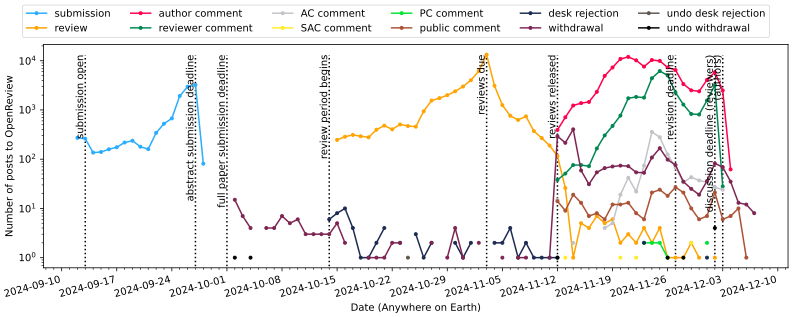
One aspect of the 'volume' of discussion is the number of posts by
authors and reviewers each day. I was interested in when authors and
reviewers post rebuttals and replies. It turned out to be no harder to
extract information on all posts from abstracts to withdrawals, which
gives a more holistic picture of activity during the review period. The
above plots the number of each type of event per day (logarithmic scale
for the counts, the spike at the review deadline is really sharp on a
linear scale).
Observations:
- Most reviews happen shortly before the review deadline. A
substantial number of reviews occur in the emergency period after
that deadline. A smaller number (but still dozens) take even longer,
with one review posted on the final day of the discussion period!
- I was expecting an even sharper spike in submissions around the
original submission deadline. However, it's not as sharp there.
Probably this is because the real push is to get the full paper in
by the full paper submission deadline. This script doesn't see when
posts were revised to include a PDF.
- The author--reviewer discussion period is characterised by several
peaks in author activity: First, immediately after reviews are
released there is a spate of withdrawals. Then, authors begin
replying, with the most active day about 10 days into the discussion
period. Reviewers become gradually more responsive, and about 5 days
later there is a peak in authors and reviewer comments. Due to an
extension in the discussion deadline, there is another peak right at
the end of the period.
- There is a consistent but low volume of public comments on some
papers. I wasn't expecting that people other than reviewers and
authors actually engage with OpenReview. I would be interested to
inspect some of these comments to see what kind of comments they are
on what kind of papers.
This puts my experience as a reviewer and author into perspective.
- As a reviewer, I submitted three reviews, respectively the day
before, of, and after the deadline. It seems this is pretty typical.
- As an author, for one paper we managed to submit rebuttals on the
17th of November. This was really early, and maybe we shouldn't have
pushed so hard. For my other paper we ran some additional
experiments and submitted our first rebuttals by Thursday 21st,
right at the first peak.
- As an author (again), unfortunately several of my reviewers
completely failed to engage with the discussion period, even though
we left plenty of time after our rebuttals. One thing that is not
clear from this plot is how many reviews or rebuttals go unanswered
by reviewers. I wonder how common this is.
- As a reviewer (again), I started getting back to my authors (those
who had posted rebuttals) from November 26th. This was just after
the reviewer activity peak, and maybe I could have found time
earlier.
Interesting!
## Wordcounts for different fields
`
`{=html}
One aspect of the 'volume' of discussion is the number of posts by
authors and reviewers each day. I was interested in when authors and
reviewers post rebuttals and replies. It turned out to be no harder to
extract information on all posts from abstracts to withdrawals, which
gives a more holistic picture of activity during the review period. The
above plots the number of each type of event per day (logarithmic scale
for the counts, the spike at the review deadline is really sharp on a
linear scale).
Observations:
- Most reviews happen shortly before the review deadline. A
substantial number of reviews occur in the emergency period after
that deadline. A smaller number (but still dozens) take even longer,
with one review posted on the final day of the discussion period!
- I was expecting an even sharper spike in submissions around the
original submission deadline. However, it's not as sharp there.
Probably this is because the real push is to get the full paper in
by the full paper submission deadline. This script doesn't see when
posts were revised to include a PDF.
- The author--reviewer discussion period is characterised by several
peaks in author activity: First, immediately after reviews are
released there is a spate of withdrawals. Then, authors begin
replying, with the most active day about 10 days into the discussion
period. Reviewers become gradually more responsive, and about 5 days
later there is a peak in authors and reviewer comments. Due to an
extension in the discussion deadline, there is another peak right at
the end of the period.
- There is a consistent but low volume of public comments on some
papers. I wasn't expecting that people other than reviewers and
authors actually engage with OpenReview. I would be interested to
inspect some of these comments to see what kind of comments they are
on what kind of papers.
This puts my experience as a reviewer and author into perspective.
- As a reviewer, I submitted three reviews, respectively the day
before, of, and after the deadline. It seems this is pretty typical.
- As an author, for one paper we managed to submit rebuttals on the
17th of November. This was really early, and maybe we shouldn't have
pushed so hard. For my other paper we ran some additional
experiments and submitted our first rebuttals by Thursday 21st,
right at the first peak.
- As an author (again), unfortunately several of my reviewers
completely failed to engage with the discussion period, even though
we left plenty of time after our rebuttals. One thing that is not
clear from this plot is how many reviews or rebuttals go unanswered
by reviewers. I wonder how common this is.
- As a reviewer (again), I started getting back to my authors (those
who had posted rebuttals) from November 26th. This was just after
the reviewer activity peak, and maybe I could have found time
earlier.
Interesting!
## Wordcounts for different fields
` `{=html}
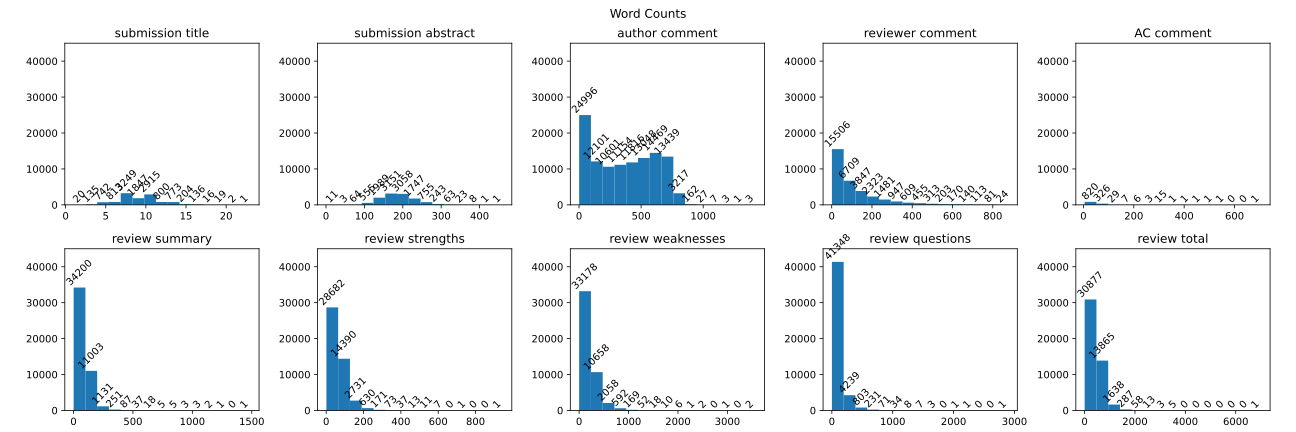
Another aspect of the 'volume' of discussion is the number of words in
each comment. Actually, what I was really interested in was the number
of words *in each review,* because I had a feeling that I may have
written the longest review at ICLR this year (based on the length of my
reviews and based on reading [Bastian Rieck's
post](https://bastian.rieck.me/blog/2019/iclr_analysis/) about ICLR 2019
review lengths). So, I scraped the contents of the reviews and comments,
counted words (nothing fancy, just `len(markdown_source.split())`) and
histogrammed the results.
Observations:
- I'm not exactly sure what to make of the stats for paper title and
abstract lengths. But it seems interesting that the average paper
has around 9--10 words in the title and an abstract under 200 words
in length.
- The author comment length distribution has a somewhat weird cutoff
at around 750 words. I think this is actually *not*
surprising---OpenReview comments have a hard limit at 5000
characters, and so if authors want to write more than this they need
to post their reply over multiple comments (my script makes no
attempt to reassemble such comment sets). 750 words seems about
right for almost filling the 5000 character limit. Actually, i think
it's the small number of responses with substantially more words
that require explanation, given this limit! Perhaps they are
comments with markdown tables (or other ASCII art?).
- Reviewer comments are systematically shorter than author comments.
Well, that perfectly matches my experience. Though there does appear
to be a pretty long tail (again barely exceeding around 750).
- As for reviews, the first four plots in the second row show the four
components of the review. It matches my experience as a reviewer and
as an author to see that the weaknesses section appears to be the
typically longest of the four sections.
- Finally, there is `review total` which is the aggregate of the
individual components, the vast majority of reviews are less than
1000 words, many less than even 500. There are a very small number
of longer reviews, going up to... around 7000 words [in one
case](https://openreview.net/forum?id=XgH1wfHSX8¬eId=xTkpGvPUqb)!
This puts my experience as a reviewer into perspective... I wrote pretty
long reviews. However, in order to preserve anonymity, I will neither
confirm nor deny that I am responsible for that 7000 word review.
## Future work
This is probably all I have the energy for until next year. But here are
some more questions about volume I would be curious to see plots for:
- How many reviews do typical papers get? I know the ACs aim for 4,
but I have personally had 7 reviews on a NeurIPS submission, which
the AC said happened because they needed a few emergency reviews and
they asked for more than they needed anticipating some wouldn't get
around to it. While exploring the ICLR data, I found [this
paper](https://openreview.net/forum?id=pCj2sLNoJq) which somehow
ended up with 12 reviews!
- Which authors have written the most words in defence of their paper?
The 7000 word review received a 9-part response. I heard a colleague
of mine who wrote a much shorter review received a disproportionate
6-part response.
- As mentioned above, how common is it for a review to go unanswered
by authors, or for an author's rebuttals to go ignored by reviewers?
This has happened for several reviewers on both of my submissions
this year, which is very disappointing, but I don't actually know
how typical it is. Some colleagues have suggested it's to be
expected. The API can tell us!
- Where is the most deeply nested comment tree? Then again, I don't
always use the 'reply to' functionality of OpenReview, and maybe
some others don't either; it would also be interesting to see the
review with greatest number of total 'child' posts!
- Is it possible to extract paper revision times from the API, to see
when people (1) uploaded PDFs compared to the deadline, and (2)
uploaded revisions as part of the rebuttal period? I want to see how
sharp a conference deadline is globally (it always feels sharp
locally).
- Most prior analyses I've seen have emphasised review scores. I'd be
interested in understanding connections between scores and volume,
building off the findings from [Bastian Rieck's
post](https://bastian.rieck.me/blog/2019/iclr_analysis/).
`{=html}
Another aspect of the 'volume' of discussion is the number of words in
each comment. Actually, what I was really interested in was the number
of words *in each review,* because I had a feeling that I may have
written the longest review at ICLR this year (based on the length of my
reviews and based on reading [Bastian Rieck's
post](https://bastian.rieck.me/blog/2019/iclr_analysis/) about ICLR 2019
review lengths). So, I scraped the contents of the reviews and comments,
counted words (nothing fancy, just `len(markdown_source.split())`) and
histogrammed the results.
Observations:
- I'm not exactly sure what to make of the stats for paper title and
abstract lengths. But it seems interesting that the average paper
has around 9--10 words in the title and an abstract under 200 words
in length.
- The author comment length distribution has a somewhat weird cutoff
at around 750 words. I think this is actually *not*
surprising---OpenReview comments have a hard limit at 5000
characters, and so if authors want to write more than this they need
to post their reply over multiple comments (my script makes no
attempt to reassemble such comment sets). 750 words seems about
right for almost filling the 5000 character limit. Actually, i think
it's the small number of responses with substantially more words
that require explanation, given this limit! Perhaps they are
comments with markdown tables (or other ASCII art?).
- Reviewer comments are systematically shorter than author comments.
Well, that perfectly matches my experience. Though there does appear
to be a pretty long tail (again barely exceeding around 750).
- As for reviews, the first four plots in the second row show the four
components of the review. It matches my experience as a reviewer and
as an author to see that the weaknesses section appears to be the
typically longest of the four sections.
- Finally, there is `review total` which is the aggregate of the
individual components, the vast majority of reviews are less than
1000 words, many less than even 500. There are a very small number
of longer reviews, going up to... around 7000 words [in one
case](https://openreview.net/forum?id=XgH1wfHSX8¬eId=xTkpGvPUqb)!
This puts my experience as a reviewer into perspective... I wrote pretty
long reviews. However, in order to preserve anonymity, I will neither
confirm nor deny that I am responsible for that 7000 word review.
## Future work
This is probably all I have the energy for until next year. But here are
some more questions about volume I would be curious to see plots for:
- How many reviews do typical papers get? I know the ACs aim for 4,
but I have personally had 7 reviews on a NeurIPS submission, which
the AC said happened because they needed a few emergency reviews and
they asked for more than they needed anticipating some wouldn't get
around to it. While exploring the ICLR data, I found [this
paper](https://openreview.net/forum?id=pCj2sLNoJq) which somehow
ended up with 12 reviews!
- Which authors have written the most words in defence of their paper?
The 7000 word review received a 9-part response. I heard a colleague
of mine who wrote a much shorter review received a disproportionate
6-part response.
- As mentioned above, how common is it for a review to go unanswered
by authors, or for an author's rebuttals to go ignored by reviewers?
This has happened for several reviewers on both of my submissions
this year, which is very disappointing, but I don't actually know
how typical it is. Some colleagues have suggested it's to be
expected. The API can tell us!
- Where is the most deeply nested comment tree? Then again, I don't
always use the 'reply to' functionality of OpenReview, and maybe
some others don't either; it would also be interesting to see the
review with greatest number of total 'child' posts!
- Is it possible to extract paper revision times from the API, to see
when people (1) uploaded PDFs compared to the deadline, and (2)
uploaded revisions as part of the rebuttal period? I want to see how
sharp a conference deadline is globally (it always feels sharp
locally).
- Most prior analyses I've seen have emphasised review scores. I'd be
interested in understanding connections between scores and volume,
building off the findings from [Bastian Rieck's
post](https://bastian.rieck.me/blog/2019/iclr_analysis/).